If you've been reading about MBBS in Norway on other websites, there's a good chance you've come away with the impression that MBBS in Norway is a free, English-taught medical degree you can walk into with a NEET score. That's not the Norway that exists in 2026. That was what MBBS in Norway used to be in 2019, not anymore.
Here's what actually stands. Norway doesn't offer a degree called "MBBS." What Indian students are really asking about is Cand.med. (Candidatus Medicinae), a six-year, 360-ECTS integrated medical program taught almost entirely in Norwegian. Since autumn 2023, non-EU/EEA students, including every Indian applicant, have had to pay tuition fees at Norway's public universities, which can amount to lakhs of rupees per year, and getting an NMC green light to practice in India afterward is genuinely an open question and just a formality.
None of this means Norway is a terrible option. It means it's a specific option, one that suits a narrow, well-prepared kind of student, and this page is written with that intent in mind. If you're seriously considering an MBBS in Norway for Indian students, or you've started to study MBBS in Norway as one option among several, you deserve the real numbers, the real language requirement, the real universities, and the real path back to India, not the copy-paste optimism you'll find on most pages, which want to sell MBBS in Norway as a shortcut.
Students we've counseled for Norway typically find the language timeline the biggest hurdle, not the entrance requirements, not even the fees, but the sheer discipline of reaching a working level of Norwegian while still finishing Class 12 or a first year of college back home. Keep that in mind as you read through the rest of this guide.
MBBS in Norway: Quick Overview
Feature | Details |
Medical Degree | Cand.med. (Candidatus Medicinae), commonly called "MBBS in Norway" by Indian students |
Duration | 6 years (360 ECTS) |
Medium of Instruction | Primarily/fully Norwegian, with some English-language material |
Main Universities | University of Oslo (UiO), University of Bergen (UiB), NTNU (Trondheim), UiT, The Arctic University of Norway (Tromsø) |
Intake | Mainly Autumn (August) |
Application Route | Samordna Opptak (bachelor/professional degrees) or direct university portals |
Norwegian Language | Required, typically Bergenstest or equal; verify per university. |
NEET | Not needed for Norwegian admission, but required under NMC rules if you plan to practice in India. |
Tuition (non-EU/EEA) | Applies since autumn 2023; figures are university- and category-specific, with some exceeding NOK 500,000/year for medicine. |
Living Cost | NOK 15,488/month (NOK 170,368/year) as the current UDI-linked estimate for 2026/27, high by any standard |
Student Permit | Studietillatelse (residence permit for studies) via UDI, not a generic visa |
India Return | Subject to case-by-case NMC/FMGL 2021 verification, not automatic |
Is MBBS Available in Norway?
Short answer: not under that name, and not the way most agents will tell you.
There is no "MBBS" degree in the Norwegian system. Norwegian universities offer the profesjonsstudium i medisin, which leads to the Cand.med. degree. A single, continuous six-year professional program rather than a separate MBBS-then-internship structure. It's the qualification that allows you to apply for medical authorization in Norway.
For Indian students, the closest useful comparison is this: Cand.med. functions the way MBBS does in India, but the packaging is different. It's longer (six full years, not five and a half), heavier on integrated ECTS credits, and, this is the part competitor sites gloss over, delivered in Norwegian from year one. If a page says "MBBS in Norway is available in English," that's not accurate for public medical faculties. Some individual courses, guest lectures, and research modules are taught in English, but you cannot complete the professional medical program in English alone.
Is Norway the Right Choice for You?
Before you go further, run yourself through this quick checklist:
Language readiness: Are you willing to spend 12–18 months reaching a working level of Norwegian beforeyour medical coursework even starts?
Budget tolerance: Can your family realistically fund NOK 500,000+/year in tuition (for the higher-fee faculties) plus NOK 170,000+/year in living costs, for six years?
Career goal: Norway/EEA vs. India return: Do you actually want to practice in Norway or elsewhere in the EEA, or is your real goal an Indian medical license?
Timeline flexibility: Are you okay with a total timeline (language prep + 6-year degree + Norwegian authorization + possible NExT/FMGE prep) that can stretch past 8 years?
If most of your answers point toward "yes," Norway is worth pursuing seriously. If you're mainly here because a consultant told you it's "cheap and English-medium," that's the myth we set out to correct on this page; please re-read the section above before going further.
MBBS in Norway Fees for Indian Students
This is the section most competitor pages get wrong, either by claiming Norway is still fully tuition-free or by quoting a single number and applying it to every university. Neither is accurate. If you're specifically searching for MBBS fees in Norway or the real MBBS in Norway for Indian students' fees, here's the honest, current picture.
Tuition Fees (2023 Policy, Explained)
Since autumn 2023, Norway's government allows public universities to charge tuition to students who are not citizens of an EU/EEA country or Switzerland. This was a deliberate policy shift; Norway had been one of the last fully tuition-free destinations in Europe for non-EU students, and that changed almost overnight for new intakes from 2023/24 onward.
MBBS in Norway fees vary meaningfully by university and program category:
NTNU (Trondheim):Uses a tiered fee system. Its highest tier, Category 3, covering medicine, dentistry, and veterinary medicine, is listed at around NOK 528,650 per year for 2026/27. That's roughly ₹53–54 lakh per year at current exchange rates, or well over ₹3 crore across a six-year program, before living costs.
University of Oslo (UiO):Confirms that non-EU/EEA students pay tuition on full-degree programs, with exact figures issued to admitted applicants per program. UiO does not run a flat-rate system, so the number you're quoted will depend on your specific admitted program category; treat any blanket figure you see online with suspicion and confirm directly with UiO before budgeting.
University of Bergen (UiB):Introduced non-EU/EEA tuition fees from the 2023/24 intake onward. UiB has been slower than NTNU to publish a detailed public fee schedule for medicine specifically, so applicants should request the current figure directly from UiB's admissions office before applying.
UiT The Arctic University of Norway (Tromsø):Reporting here is genuinely mixed. Some sources report that UiT has, at various points, continued to waive tuition for non-EU/EEA students even after the 2023 reform took effect elsewhere; other general Norway guides list UiT under the same fee-liable policy as every other public university. Do not take either claim at face value; confirm UiT's current fee status for the medicine program directly with the university before applying, since this is exactly the kind of detail that changes year to year and gets copied inaccurately across blogs.
MBBS in Norway fee structure, in short: there is no single national number. Budget for the possibility of a fee at the higher end (NOK 400,000–530,000+/year) at NTNU-level pricing, and verify the exact figure for your target university every single admission cycle; the government has signaled fees will keep being "adjusted annually."
Semester Fee
On top of tuition (or instead of it, if you're an EU/EEA citizen), every student pays a small semester registration fee to the local student welfare organization, typically NOK 550–690 per semester (roughly NOK 1,100–1,400/year, or about ₹11,000–14,500). This covers welfare services, some reimbursement of medical costs, and access to subsidized accommodation; it is not the same as tuition, and no, it does not mean the degree is "basically free."
Accommodation, Food, Transport, Insurance, Study Materials
Accommodation:Student housing through SiO (Oslo), Sammen (Bergen), SiT (Trondheim), or the Tromsø equivalent runs roughly NOK 4,000–7,000/month depending on city and room type. Private rentals cost more, especially in Oslo.
Food:Budget NOK 3,000–4,500/month if you cook most meals at home; eating out regularly in Norway is genuinely expensive by Indian standards, easily NOK 200–300 for an average restaurant meal.
Transport:A monthly student transit pass runs roughly NOK 400–700 depending on the city.
Health insurance:Students registered for 12+ months join the Norwegian National Insurance Scheme through the semester fee; shorter stays or exchange terms may need separate private insurance.
Study materials:Medical textbooks and course materials can add NOK 3,000–6,000/year, though many are available digitally or through university libraries.
Total Estimated 6-Year Cost
Putting it together honestly, for a student at a higher-fee faculty like NTNU:
Tuition: NOK 528,650 × 6 ≈ NOK 3.17 million
Living costs (UDI benchmark): NOK 170,368 × 6 ≈ NOK 1.02 million
Semester fees: NOK 1,400 × 12 semesters = NOK 16,800
Rough six-year total: NOK 4.2–4.3 million, or approximately ₹4.3–4.4 crore at current exchange rates (₹10.2/NOK, August 2026). At UiT, if it turns out tuition-free status still applies at the time you apply, the total drops to roughly the living-cost figure alone, around NOK 1 million (₹1 crore), which is exactly why confirming UiT's current fee policy before you commit matters so much.
No competitor page currently publishes a total like this. It's not a pleasant number, but it's the number, and it's the reason this decision needs 18–24 months of planning, not a rushed application season.
Cost of Living in Norway for Indian Students
Norway is consistently ranked among Europe's most expensive countries to live in, and medical students, who have less flexibility to work part-time than students in lighter programs, feel this acutely.
City | Approx. Monthly Living Cost | Student Room (Monthly) | Notes |
Oslo | NOK 13,000–15,000 | NOK 5,000–7,000 | Most expensive; also has the largest Indian community and most services |
Bergen | NOK 11,500–13,500 | NOK 4,000–6,000 | Slightly cheaper than Oslo; strong medical faculty at UiB |
Trondheim | NOK 11,500–13,500 | NOK 4,000–6,000 | Large student population keeps some costs competitive |
Tromsø | NOK 11,500–13,500 | NOK 4,000–6,000 | Cheapest overall day-to-day, though Arctic winter adds heating/clothing costs |
For visa purposes, the figure that actually matters is the UDI-mandated proof-of-funds amount, currently NOK 15,488/month or NOK 170,368/year for the 2026/27 academic year. This is a minimum you must document to get your study permit; it isn't a suggestion, and it's reviewed and adjusted annually, so always check UDI's website directly before your application cycle.
Cost Calculator: Your Total 6-Year Budget
None of the five competitor sites we reviewed while researching this page offer a way actually to total up your personal cost; they show isolated numbers (tuition here, rent there) and leave you to do the maths. Here's a simple way to build your own estimate, university by university.
Add up these five line items for your target university:
Annual tuition: Ranges from effectively zero (if UiT's fee-waiver status holds at your admission cycle) to roughly NOK 528,650/year (NTNU's Category 3 rate); confirm the current figure for your specific university before using it
Annual living cost: NOK 138,000–180,000/year depending on city (based on the NOK 11,500–15,000/month range above)
Semester fees: Roughly NOK 1,100–1,400/year
Norwegian language course: A one-time cost of roughly ₹80,000–₹2,50,000 before you start, not repeated annually
Miscellaneous:(Travel, insurance top-ups, study materials, visa renewal fees), budget roughly NOK 10,000–15,000/year
Formula: (Annual tuition + annual living cost + semester fees + misc) × 6 years, plus the one-time language course cost.
For a student at NTNU: (NOK 528,650 + NOK 156,000 + NOK 1,400 + NOK 12,000) × 6 ≈ NOK 4.19 million, plus roughly ₹1.5 lakh for language prep, landing close to the ₹4.3–4.4 crore total quoted earlier in this guide.
For a student at a hypothetical fee-waived university: NOK 170,368/year × 6 ≈ NOK 1.02 million (₹1.04 crore), plus language prep, a very different number, which is exactly why confirming your specific university's fee status matters more here than almost anywhere else in this guide.
We'd rather you do this maths with real, current numbers from us than discover the true total halfway through year two in Norway.
Top Medical Universities in Norway
Only four public universities in Norway run the full six-year Cand.med. professional program. If you're comparing colleges in Norway for MBBS, this is the complete list, not the padded "Top 10" you'll find elsewhere, most of which mix in unrelated nursing or general health institutions that don't actually offer a medical degree.
University of Oslo (UiO)
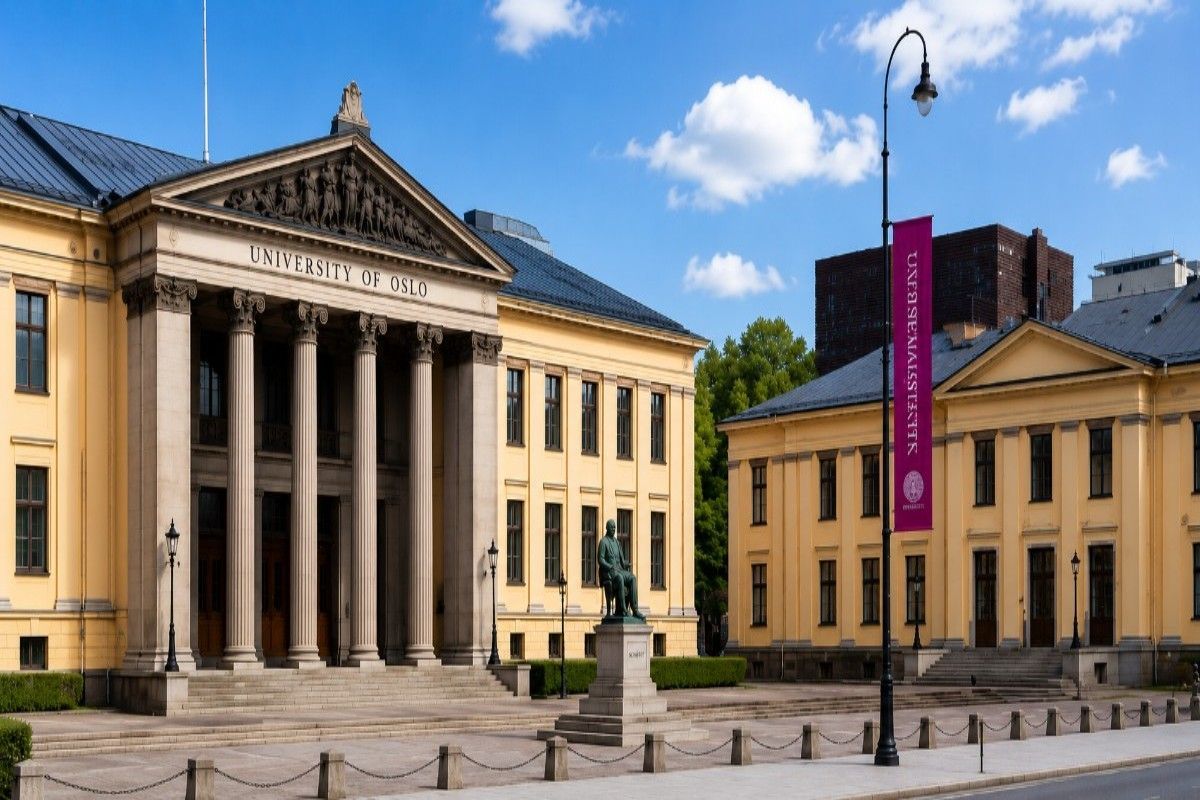
Norway's oldest and largest university, founded in 1811, with its Faculty of Medicine spread across several Oslo-area teaching hospitals rather than at a single central campus hospital. UiO is the most competitive of the four faculties for admission and sits in the capital, which means higher living costs but also the widest range of clinical specialties and research groups. Non-EU/EEA students pay tuition on a program-specific basis; request the exact current figure from UiO admissions before applying. UiT and UiO's language requirements, like the others, demand a solid working level of Norwegian before clinical years begin. For Indian students specifically, Oslo's advantage is its community: it has the largest Indian and South Asian student population of the four cities, which can meaningfully ease the first-year adjustment, from finding familiar groceries to having peers who've already been through the visa process.
University of Bergen (UiB)
UiB's medical program follows the "Medisin 2015" study plan, splitting each admitted cohort into an A-cohort and a B-cohort starting in the fourth year, with close clinical ties to Haukeland University Hospital. Instruction is primarily in Norwegian, with limited English content in parts of the curriculum. Bergen is smaller and somewhat more affordable than Oslo, and UiB has introduced non-EU/EEA tuition fees since 2023/24; again, confirm the medicine-specific figure directly rather than relying on a general university-wide number.
NTNU (Trondheim)
NTNU has published one of the more transparent fee schedules among Norwegian universities, placing medicine, dentistry, and veterinary medicine in its top pricing tier, around NOK 528,650/year for 2026/27. NTNU is strong in research-integrated learning and is located in Trondheim. In this genuinely large student city, roughly one in five residents is a student, which helps with the cost of living and community life, even if tuition is on the higher side. NTNU is also unusual in stating plainly that it does not typically offer scholarships or payment plans for non-EU/EEA tuition, a level of directness few competitor pages mention, but one that matters greatly for financial planning.
UiT The Arctic University of Norway (Tromsø)
UiT offers something the other three don't: real exposure to Arctic and rural medicine, including outreach to remote northern communities. Its non-EU/EEA application deadline for the medicine program is notably earlier than Samordna Opptak's, around mid-November for the following autumn intake, so don't assume you have until April. UiT's tuition-fee status for non-EU students has been reported inconsistently across sources; verify this directly with UiT before budgeting, since getting it wrong by NOK 500,000/year is not a small planning error.
Medical University Comparison Table
University | City | Degree | Duration | Language | Application Route | Tuition (non-EU, indicative) | Key Strength |
University of Oslo | Oslo | Cand.med. | 6 years | Norwegian | Samordna Opptak / direct | Program-specific, confirm with UiO | Widest hospital network, capital-city research access |
University of Bergen | Bergen | Cand.med. | 6 years | Norwegian | Samordna Opptak / direct | Program-specific, confirm with UiB | Strong ties to Haukeland University Hospital |
NTNU | Trondheim | Cand.med. | 6 years | Norwegian | Samordna Opptak / direct | NOK 528,650/year (Category 3, 2026/27) | Research-integrated curriculum, large student city |
UiT | Tromsø | Cand.med. | 6 years | Norwegian | Direct (non-EU deadline Nov 15) | Status disputed, verify directly | Arctic/rural medicine, earlier and separate deadline |
Is NEET Required for MBBS in Norway?
This needs a clean three-way split, as most pages blur it into a single, confusing paragraph.
Norwegian university admission requirement: No. Norwegian universities do not ask for a NEET score. Admission runs on Norwegian academic equivalency, the GSU list, and language proficiency.
Indian regulatory (NMC) requirement: Yes, in effect. Under Indian rules, students planning to practice in India after a foreign medical degree generally need to have appeared for NEET, because NEET eligibility is tied to how NMC evaluates your route back into Indian licensing.
India-return licensing requirement: Related to point 2, without a valid NEET-linked eligibility, your path to sitting the required Indian licensing exam (see the NExT/FMGE section below) gets significantly harder, regardless of how strong your Norwegian degree is.
So: an MBBS from India can practice in Norway. The reverse question is actually the one people should be asking; going from Norway back to India is the harder direction, not Norway's own admission process.
Is MBBS in Norway Available in English?
If you're specifically searching for MBBS in Norway in English, the honest answer is no, not as a complete, English-medium professional program at any of the four public medical faculties. This is one of the two biggest myths this entire guide exists to correct (the other being "tuition-free"). You'll find English-taught master's programs in Norway across many fields, and you'll find English-language research seminars and elective modules inside the medical faculties. But the core six-year clinical program, the one that actually produces a licensed doctor, runs in Norwegian, because patient communication and clinical placements require it. If a site says otherwise, verify it directly on the university's own admissions page before believing it.
Norwegian Language Requirements for Medical Studies
Why It's Required
Clinical training involves working with real patients in Norwegian hospitals and clinics. There's no version of this program where you can defer the language to "later"; you need working proficiency before clinical rotations start, and reasonable proficiency well before that for lectures and exams.
Admission-Level Requirement
This varies by university and program; don't take a blanket "B2 everywhere" claim at face value. Confirm the exact required level with each university's admissions office, since requirements are reviewed periodically.
Accepted Tests
The two most commonly accepted Norwegian-language qualifications for university admission are the Bergenstest and Norskprøve (specifically the higher levels). Some universities also accept university-run Norwegian-as-a-foreign-language courses as a substitute pathway.
Realistic Prep Timeline
Reaching the level Norwegian medical faculties expect typically takes Indian applicants with no prior Norwegian exposure 12–18 months of structured study, not the "few months" some pages imply. Factor this into your overall timeline before your intended intake year, not after you've already applied.
Approximate Course Cost
Intensive Norwegian courses (in India or in Norway) generally cost ₹80,000–₹2,50,000 in total, depending on format, intensity, and whether it's done online or in-country; treat this as an additional line item in your budget, separate from tuition and living costs.
Relevance to Clinical Work and Licensing
Beyond passing exams, your Norwegian proficiency directly affects patient safety in clinical placements and is scrutinized again during the Norwegian medical authorization process after graduation.
Application Deadlines
University/Route | Applicant Type | Deadline (2026/27 cycle) |
Samordna Opptak (general route) | Most applicants with foreign qualifications, incl. Indian students | Application window: 1 Feb – 15 April 2026 |
UiT (direct, non-EU/EEA) | Non-EU/EEA international applicants | Portal opens 15 Oct 2025; deadline 15 Nov 2025 for Autumn 2026 intake |
UiT (direct, EU/EEA/Swiss) | EU/EEA applicants | Portal opens 1 Feb 2026; deadline 1 Mar 2026 |
NTNU / UiT medicine via Samordna Opptak | General applicants | Both have historically listed 15 April as the Samordna Opptak deadline; verify this is still current before applying. |
UiO / UiB | General applicants | Confirm current-cycle deadlines directly; do not assume they match NTNU/UiT. |
Don't generalize "October to March" the way several competitor pages do. UiT's non-EU deadline in particular falls nearly five months before the general Samordna Opptak deadline; missing that distinction is one of the most common timeline mistakes Indian applicants make.
MBBS in Norway Curriculum & Syllabus
Curriculum structure differs meaningfully between universities, so treat any single "Year 1 to Year 6" table you see online as a rough approximation, not a universal syllabus. As one concrete example, UiB's Medisin 2015 study plan splits each admitted cohort into an "A-cohort" and "B-cohort" starting in year four, with the B-cohort getting a free term after year three, a structural detail that doesn't exist at the other faculties. Broadly, though, most Norwegian medical programs follow this shape:
Years 1–2:Foundational sciences, anatomy, physiology, biochemistry, and early patient-contact modules
Years 3–4:Pathology, pharmacology, and the beginning of structured clinical rotations
Years 5–6:Full clinical rotations across hospital departments, electives, and (at most faculties) a research thesis component
Always check the specific study plan (studieplan) published by your target university before finalizing your choice; the differences are real, not cosmetic.
Clinical Training in Norway
Clinical years are spent in actual public hospitals. UiB students train extensively at Haukeland University Hospital in Bergen; UiO students rotate across multiple Oslo hospitals; and UiT uniquely extends training into rural and Arctic primary-care settings, giving students exposure to remote-medicine scenarios that few other MBBS-abroad destinations offer. Simulation labs supplement live clinical exposure across all four faculties, and most programs include a research component in the later years.
Medical Internship / Licensing in Norway
After completing the six-year Cand.med. degree, graduates move into the Norwegian medical authorization process rather than a separate "internship year" tacked onto the degree, as some competitor pages describe. Don't copy old "18-month internship" claims without checking; Norway's authorization structure has been reviewed and adjusted in recent years, and the exact current requirements (supervised practice period, specific registration steps) should be confirmed against the Norwegian Directorate of Health's current guidance before you rely on it for planning. Broadly, the path runs: graduation → Norwegian medical authorization → entry into postgraduate/specialist training (LIS1, LIS2, LIS3 stages).
Scholarships for MBBS in Norway
Be prepared for a short answer here: most general scholarships for non-EU/international students were withdrawn starting 2025, alongside the broader tuition reform, and international enrolment has reportedly dropped by roughly half as a result. What's realistically still available:
Program-specific fundingat individual faculties (NTNU, UiO, and a few others occasionally fund specific master's-level or research-linked programs; check each program's own scholarship page, since there's no single national pool)
Lånekassen(the Norwegian State Educational Loan Fund), generally aimed at Norwegian/EEA residents, with limited applicability for Indian non-EEA students; verify current eligibility rather than assuming access
Bilateral/government-funded schemes, occasionally available through Indian government study-abroad funding bodies or specific partnership agreements; check what's currently offered rather than relying on scholarship names quoted on other blogs, several of which reference programs no longer active
Part-time work, legally permitted (see below) but not a realistic way to fund tuition-level costs for a medical degree
Do not trust any page listing specific named scholarships for MBBS in Norway without checking that scholarship's current status directly. This space has changed substantially since 2025, and outdated scholarship names circulate widely.
Can Indian Students Work While Studying?
Yes, students on a study permit are generally allowed to work part-time during term (commonly up to 20 hours/week) and full-time during official holiday periods. Realistic earnings from part-time student work in Norway help cover incidental costs, not tuition-scale expenses; this is worth saying plainly, because some pages imply part-time work meaningfully offsets a NOK 500,000/year fee, which it does not. Also worth flagging: healthcare-adjacent part-time roles are effectively closed to students who haven't reached working Norwegian proficiency, which narrows realistic job options in your early years.
Career Opportunities After MBBS in Norway
Working in Norway
Requires completing the Norwegian medical authorization process after graduation; this is not automatic upon finishing the Cand.med. degree.
Residency/Specialization Structure & Duration
Norway's postgraduate structure comprises staged specialist training (LIS1 through LIS3), with total specialization timelines typically extending several years beyond the base degree, varying by specialty.
Research/PhD Pathways
All four faculties support this, with UiT specifically highlighted for its research and PhD opportunities tied to Arctic and rural health, a genuine differentiator if research interests you.
Public Health / Healthcare Management
Graduates can move into public health administration roles within Norway's well-developed public health infrastructure.
International Careers (UK/USA/Australia Licensing Routes)
Because Norway is part of the EEA rather than the EU proper, portability of a Norwegian medical license to other EU countries generally follows EEA-based recognition routes rather than direct EU membership pathways; this requires country-specific research rather than assuming automatic recognition. Licensing into the UK, US, or Australia involves those countries' own separate medical-registration exams and processes, similar to what any foreign medical graduate would face.
Returning to India
Fully covered in the dedicated section below, this is the single most important section on this page for most Indian applicants, so don't skip it.
Medical Career Salary in Norway
Position | Approximate Annual Salary (verify and date before relying on this) |
Junior/Resident doctor (LIS1) | Public-sector resident pay scales apply; figures vary by region and hospital; check current Norwegian public-sector salary tables (Legeforeningen) rather than third-party blog estimates. |
General Practitioner (fastlege) | Among the higher-earning tiers within Norwegian primary care; exact figures fluctuate with self-employment structure and patient list size. |
Specialist | Meaningfully higher than resident-level pay, varying widely by specialty and hospital |
Medical researcher | Comparable to standard Norwegian academic/research salary bands, separate from clinical pay |
We're deliberately not printing specific rupee or krone figures here that we can't verify against a current, dated, primary source; several competitor pages reuse old, unverified salary numbers (including at least one that appears to have copied Future MBBS's figures without checking them). Before making any financial decision based on projected Norwegian doctor salaries, check the Norwegian Medical Association (Legeforeningen) salary data directly, as it's more up-to-date and more reliable than any consultancy blog.
Postgraduate Medical Specialization in Norway
Norway's specialist training runs through a structured LIS (Leger i spesialisering) pathway rather than a single unified "PG" system. LIS1 is the initial supervised period after graduation, followed by LIS2/LIS3 stages specific to your chosen specialty. Total time to become a fully qualified specialist typically runs several years beyond the base six-year degree. A PG in Norway after MBBS in India, specifically, an Indian MBBS graduate seeking postgraduate training in Norway rather than a Norway-trained graduate, entails separate credential recognition steps through Norwegian authorities, distinct from the pathway available to Cand.med. graduates of Norwegian universities themselves. UiT stands out here again for actively promoting research/PhD routes alongside clinical specialization.
MBBS in Norway: Is the Degree Valid in India?
This is the section where honesty matters more than anywhere else on this page, and it's the section most competitor sites either skip or oversimplify into a confident "Yes."
The accurate answer is: it depends, and it's verified on a case-by-case basis. The National Medical Commission (NMC) does not maintain or publish a blanket-approved list of foreign medical universities. Each Indian student's foreign medical qualification is assessed individually against the Foreign Medical Graduate Licentiate (FMGL) Regulations, 2021, which set out requirements including:
A minimum 54-monthduration of the medical degree program
English-medium instructionfor the qualifying program
A 12-month internship at the same institutionwhere the degree was completed
Here's the direct tension this creates for a Norway-trained doctor: Norway's Cand.med. program is six years (well above the 54-month floor, so that part clears easily). Still, it is taught in Norwegian rather than English, which directly conflicts with the FMGL's English-medium instruction requirement as commonly interpreted. This is not a minor technicality; it's the single biggest reason an MBBS from India can practice in Norway is actually a more straightforward question than the reverse.
What this means practically:
Do notassume automatic NMC recognition just because Norway is a "developed," EEA-linked country.
If your goal is genuinely to return and practice in India, get a written, current assessment from NMC (or a qualified education-regulatory consultant who works specifically with FMGL cases) before committing to six years and several crore rupees in Norway.
NExT (National Exit Test)is the licensing exam pathway increasingly relevant here; foreign medical graduates are expected to clear NExT (which is gradually replacing the older FMGE structure) to practice in India. Track NExT's rollout status closely, as the exact requirements for foreign-trained graduates are evolving.
No blog should ever tell you "Yes, Norway's MBBS is NMC-approved" as a blanket statement. If you read that anywhere else, that page is either outdated or not being straight with you.
Advantages and Disadvantages of MBBS in Norway
Advantages | Disadvantages |
World-class, hospital-integrated clinical training | Non-EU/EEA tuition fees since 2023, some faculties above NOK 500,000/year |
Strong research and Arctic/rural medicine niche (UiT) | Full program taught in Norwegian, genuine 12–18 month language barrier |
High standard of living, safety, healthcare quality | Extremely high cost of living, especially in Oslo |
Small cohorts, high per-student clinical exposure | Very limited, highly competitive non-EEA seats |
EEA-recognized degree | NMC/India-return recognition is case-specific, not guaranteed |
Well-resourced public hospitals for training | Sharp culture shift, reserved social norms, low parental/community involvement compared to India |
Genuine outdoor/nature-driven student life | Harsh winters, near-zero daylight in parts of the north for weeks at a time |
Since-2025 scholarship pool largely dried up. | Fewer financial cushions than the 2023-and-earlier era this route was known for |
MBBS in Norway vs Other Countries
Country | Degree Type | Language | Tuition (Non-EU, approx.) | Living Cost | Admission Difficulty | India-Return Suitability | Best-Fit Student |
Norway | Cand.med. | Norwegian | High (NOK 400,000–530,000+/yr at some faculties) | Very high | High (very limited seats) | Case-specific, language-instruction conflict with FMGL | Students prioritizing EEA-quality training over an easy India-return path |
Germany | Staatsexamen (Medicine) | German | Low/free at most public unis, some new fees emerging | High | High | Generally stronger, check current FMGL fit | Students comfortable with German and long-term EU plans |
Georgia | MD | English (widely available) | Moderate | Low–moderate | Low–moderate | Popular route, but verify current NMC screening pass rates | Budget-conscious students wanting English-medium |
Bangladesh | MBBS | English | Low–moderate | Low | Moderate | Established, well-trodden India-return route | Students prioritizing proximity and predictable FMGE/NExT outcomes |
Poland | MD | English (int'l tracks) | Moderate–high | Moderate | Moderate | Reasonably well-established | Students wanting EU exposure with English instruction |
Hungary | MD | English | Moderate–high | Moderate | Moderate–high | Established route | Strong academic students wanting reputed EU medical schools |
Italy | Medicine and Surgery | Italian/English tracks | Low (income-based) | Moderate–high | High (entrance exam) | Generally workable | Students who can clear the entrance exam and prefer income-linked fees |
Sweden | Läkarprogrammet | Swedish | High for non-EU | Very high | Very high | Similar language-instruction issue as Norway | Rarely first choice for Indian students due to similar constraints |
Romania | MD | English | Low–moderate | Low–moderate | Low–moderate | Established route | Budget-conscious students seeking EU degree with English instruction |
Russia | MBBS/MD | English (widely available) | Low | Low | Low | Very well-established, high FMGE historical volume | Students prioritizing affordability and India-return track record |
The pattern that jumps out: among all MBBS-abroad options, MBBS in Norway is the only one where the primary barrier isn't cost or entrance exams; it's the combination of tuition, an unavoidable language requirement, and an India-return conflict, three obstacles stacked together in a way most alternative destinations don't replicate.
If you're weighing these side by side, it's worth reading our dedicated guides on MBBS in Germany, MBBS in Georgia, and MBBS in Bangladesh. Each destination has its own quirks that a single comparison table can only summarize, not fully explain. Our MBBS Abroad hub page also breaks down how to shortlist a country based on your budget and India-return priorities, and our NEET for MBBS Abroad and FMGE/NExT explainer pages go deeper into the licensing side of this decision than we've had room for here.
Is Norway a Good Choice for Indian Students?
Norway may suit you if:
You're targeting a long-term career in Norway or elsewhere in the EEA, not necessarily India
You can commit 12–18 months to reaching working Norwegian proficiency before your degree even starts
Your family can comfortably fund NOK 500,000+/year tuition (worst case) plus high living costs for six years
You're drawn specifically to research, Arctic/rural medicine, or EEA-integrated healthcare systems
You're comfortable with a genuinely uncertain, case-by-case NMC recognition outcome if you ever want to return
Norway is probably not right for you if:
Your main goal is a straightforward, predictable path back to practicing in India
You were told (or assumed) that Norway is tuition-free and English-taught
You're not willing or able to invest over a year in Norwegian language study before starting
Your budget is closer to what other popular MBBS-abroad destinations require
You want NEET-based entry to feel meaningful in the admission process itself (it isn't, for Norwegian universities)
Common Mistakes Indian Students Make
Nobody else covers this list in one place; most of it comes directly from patterns other guides either miss entirely or bury in passing mentions:
Assuming an English-medium MBBS pathway exists at Norwegian public medical faculties (it doesn't)
Assuming "public university" automatically means free for everyone, including non-EU/EEA students (it hasn't, since 2023)
Ignoring or underestimating the Norwegian language requirement's real timeline
Assuming NEET is irrelevant to their Norway plan altogether, instead of understanding it matters for the India-returnleg
Assuming automatic NMC recognition of a Norwegian medical degree, without checking FMGL 2021's English-medium instruction requirement
Ignoring the internship/authorization-structure details and assuming Norway's post-graduation path mirrors India's
Calculating only tuition and forgetting that Norway's living costs are just as high a line item
Not documenting the UDI proof-of-funds requirement early enough, causing visa delays
Skipping the GSU-list equivalency check, then discovering late that their Class 12 alone doesn't qualify without an added year of university study
Picking a university off an unverified "top 10 medical colleges in Norway" list that includes institutions that don't actually run full medical programs
Recent Updates / Trends
2023:Non-EU/EEA tuition fees introduced at Norwegian public universities for the first time in decades, applying to new intakes from autumn 2023 onward.
2025:General scholarships for international/non-EU students were largely withdrawn across the system.
2025–26:International enrolment at Norwegian universities has reportedly dropped by roughly 50% following the fee and scholarship changes.
2026/27:NTNU has published its updated Category 3 (medicine) tuition figure at approximately NOK 528,650/year; UDI's proof-of-funds requirement stands at NOK 170,368/year for the current academic year. Both figures are reviewed and adjusted annually; this page will be revisited to track changes.
Conclusion
MBBS in Norway, or more accurately, Cand.med. in Norway isn't the free, easy, English-medium shortcut a lot of consultancy pages still describe. Anyone researching MBBS in Norway in 2026 deserves the version of this story that includes the real fees, not just the highlight reel. It's a genuinely strong medical education wrapped in real costs: high tuition at most faculties, a serious language commitment, very limited seats, and a return-to-India path that needs individual verification rather than blind faith. It suits a specific kind of student, financially prepared, genuinely willing to learn Norwegian, and clear-eyed about whether their long-term goal is Norway itself or a license back home. If that's you, this is one of the strongest medical education systems in Europe. If it's not, there are other MBBS-abroad routes built more specifically around a predictable return to Indian practice, and it's worth being honest with yourself about which category you fall into before you commit six years and a significant sum to this path.
Decision Scorecard
Factor | Rating (out of 5) |
Affordability | ★★☆☆☆ (tuition alone can exceed NOK 500,000/year at NTNU; UiT status needs verification) |
Academic Quality | ★★★★★ (hospital-integrated teaching, small cohorts, high per-student clinical exposure) |
Clinical Exposure | ★★★★☆ (real hospital hours from the clinical years, plus UiT's unique Arctic/rural rotations) |
Safety | ★★★★★ (Norway ranks near the top of most global safety indices) |
Student Life | ★★★★☆ (established international communities at UiO and NTNU; strong outdoor/nature culture) |
Cost of Living | ★★☆☆☆ (NOK 11,500–15,000/month, among the highest in Europe) |
International Recognition | ★★★☆☆ (EEA-recognized degree, but NMC/FMGL recognition for India-return is case-specific, not automatic) |
Climate Tolerance Needed | ★★☆☆☆ (harsh winters everywhere; near-zero daylight in Tromsø for parts of December–January) |