If you’ve spent even a minute researching MBBS in Cyprus, you’ve probably noticed the same problem I ran into while putting this blog together: almost nobody agrees on the numbers. One site says tuition is €7,500, another says €25,000, a third throws around “NMC approved” like it’s a stamp of duty for a genuine MBBS Abroad option. None of that is malicious; it’s just outdated or lazily copied information. So, before we go further, here’s the one thing worth understanding upfront: Cyprus isn’t one country for medical education purposes; it’s two, with two completely different sets of universities, degrees, and recognition pathways. Get that distinction wrong and everything else you plan around it- fees, visa, NMC eligibility- falls apart.
This page
walks through both sides honestly: what each university actually charges going into 2026-27, what the National Medical Commission actually requires (not what consultants claim), what your total six-year bill really looks like once you add hostel, food, insurance and flights, and, just as importantly, who should probably look elsewhere.
Quick terminology note before we start: most Cyprus universities don’t technically award an “MBBS.” They award an MD (Doctor of Medicine) or occasionally a DVM/D.Med depending on the school. In Indian usage, “MBBS in Cyprus” and “MD in Cyprus” refer to the same six-year undergraduate-entry medical degree; I’ll use both terms interchangeably throughout this guide, as most Indian students search for it.
Quick Highlights of MBBS in Cyprus at a Glance
Parameter | Details |
Degree awarded | MD (Doctor of Medicine), commonly referred to as “MBBS in Cyprus” in India. |
Course duration | 6 years (includes final-year clinical internship) |
Medium of instruction | English (all universities covered here) |
NEET requirement | Mandatory for Indian students under current NMC rules |
English test | IELTS/TOEFL, or a waiver if your prior schooling was in English (varies by university) |
Entrance exam | None of the six universities in this guide require a separate entrance test for MBBS. |
Tuition range (Republic of Cyprus) | €22,000 – €25,000/year (approx. ₹24.2L – ₹27.5L) |
Tuition range (North Cyprus/TRNC) | €5,800 – €12,955/year (approx. ₹6.4L – ₹14.2L) |
Cost of living | €600–€1,000/month (Republic side); €300–€500/month (North Cyprus) |
Intake | September (primary); some universities also run a February/spring intake |
Currency | Euro (€) island-wide, though North Cyprus institutions often quote fees in USD |
Recognition status | Varies sharply by institution and by which side of Cyprus it’s on; see the dedicated section below before shortlisting anything. |
Introduction to MBBS in Cyprus
Cyprus has become a genuine contender in the “MBBS abroad” conversation over the last five or six years, and the reasons are fairly simple rather than marketing fluff:
English-medium degrees end to end, no foundation year in a foreign language, unlike several Central Asian or Eastern European options.
EU/ECTS academic system on the Republic of Cyprus side, meaning credits are transferable and the degree structure follows a recognizable European format.
Modern teaching hospitals and simulation labs, particularly at the newer medical schools that were built specifically to attract international students.
A genuinely international student body; Cyprus hosts students from over 100 countries, so classrooms rarely feel like a single-nationality bubble.
Mediterranean lifestyle and climate, which matters more than people admit when you’re six years into a demanding degree far from home.
Research exposure at institutions like the University of Nicosia, which runs active programs in cancer biology, regenerative medicine, and infectious disease.
None of this means Cyprus is automatically the right choice for you; it depends heavily on which university and which side of the island you’re looking at, which is exactly what the rest of this guide untangles.
Is Cyprus Good for Indian Students?
On a practical, day-to-day level, yes, with caveats. Food is genuinely manageable; most university towns (Nicosia especially) have Indian grocery stores, and at least a handful of Indian restaurants, and Cypriot cuisine itself (grilled meats, halloumi, fresh produce) isn’t a difficult adjustment for most Indian students. The Indian student community, while smaller than in, say, Georgia or the Philippines, is active and growing with every intake.
Safety is a genuine strength; Cyprus consistently ranks among the safer countries in Europe for international students, with low rates of violent crime. The climate is warm for most of the year, which Indian students tend to adjust to quickly. Cultural adjustment is moderate: English is widely spoken, but Greek (Republic side) or Turkish (North Cyprus) dominates daily life outside campus, so a few basic phrases go a long way.
The honest downside is distance and homesickness. A direct or one-stop flight from major Indian cities to Larnaca or Ercan takes anywhere from 6 to 10 hours, depending on the route, and round-trip fares typically run ₹35,000–₹65,000, making it not a casual weekend trip home.
MBBS/MD in Cyprus vs MBBS in India
Factor | MBBS in Cyprus | MBBS in India |
Admission basis | NEET score + university-specific criteria (no cutoff-based merit list) | NEET rank through All India/State counseling |
Seat availability | Rarely a bottleneck; private universities have far more seats than applicants. | Extremely limited government seats; private seats very expensive |
Tuition (6 years, approx.) | ₹40 lakh – ₹1.5 crore depending on university | ₹6 lakh (govt) to ₹1–1.5 crore (private) |
Degree awarded | MD (Doctor of Medicine) | MBBS |
Duration | 6 years | 5.5 years (incl. 1-year internship) |
Licensing to practice in India | Must clear NExT (National Exit Test) as a Foreign Medical Graduate | Must clear NExT as a domestic graduate |
Competition at entry | Low; admission is largely NEET-qualifying + document-based | Extremely high, top NEET percentile needed for govt seats |
Clinical training environment | European hospital systems (Republic side) or JCI-linked hospitals (some North Cyprus universities) | Indian government/private teaching hospitals |
The trade-off in one line: Cyprus removes the NEET-rank bottleneck at entry but adds a mandatory NExT screening test and FMGL compliance check at exit. Neither path is “easier”; the difficulty moves from admission to licensing.
Republic of Cyprus vs North Cyprus (TRNC) The Distinction Every Website Skips
This is, without exaggeration, the single most important section in this entire guide, and it’s the one place where most MBBS-in-Cyprus content online goes vague or silent. If you read nothing else, read this.
Cyprus, as a landmass, is politically divided into two parts:
Republic of Cyprus: An internationally recognized, sovereign European Union member state since 2004. It controls the southern, larger part of the island, including the southern half of the capital, Nicosia, Limassol, Larnaca, and Paphos. This is the Cyprus that appears in EU statistics, uses the Euro as its official currency, and whose universities, like the University of Nicosia and European University Cyprus, award degrees recognized across all 27 EU member states.
Northern Cyprus (Turkish Republic of Northern Cyprus / TRNC): A self-declared state that occupies the northern third of the island. It is recognized as a sovereign country by Turkey alone. The United Nations, the European Union, and virtually every other country in the world, including India, do not recognize TRNC as an independent state; they consider it Cypriot territory under Turkish military occupation, per longstanding UN resolutions. Universities like Near East University, Cyprus International University, Eastern Mediterranean University, and Girne American University are located here.
Why this matters for your medical degree
This isn’t a footnote; it changes several concrete things:
Banking and money transfers: TRNC operates its own banking arrangements separate from the EU financial system. Wiring tuition fees, receiving remittances, and general international banking can involve extra steps compared to the Republic of Cyprus, which uses standard EU/SEPA banking.
Visa and residence permits: Entry to TRNC for most nationalities (including Indian passport holders) typically routes through Turkey or via Ercan Airport with specific TRNC entry requirements, different from the Republic of Cyprus’s EU Schengen-adjacent (but not full Schengen) visa process.
Degree recognition: A degree issued by a TRNC-based university is not automatically an “EU degree” the way a Republic of Cyprus degree is, because TRNC itself isn’t recognized as a state by the EU. This doesn’t necessarily mean the medical education is lower quality; several TRNC universities are WDOMS-listed and internationally accredited, but it does mean you, personally, carry the burden of independently verifying that your specific program satisfies NMC’s FMGL requirements, since there’s no “it’s automatically EU-recognised” shortcut here.
NMC verification: The NMC evaluates degrees based on the FMGL Regulations criteria (duration, medium of instruction, clinical training, internship location), not based on political recognition of the country. A TRNC degree can satisfy FMGL requirements if the university and program meet the criteria. But because TRNC isn’t a conventionally recognized state, students researching independently (rather than relying on a consultant’s claim) is even more critical here than on the Republic side.
Republic of Cyprus vs North Cyprus Comparison Table
Factor | Republic of Cyprus | North Cyprus (TRNC) |
International recognition | Sovereign UN member state, EU member since 2004 | Recognized only by Turkey; not recognized by UN, EU, or India |
Universities covered in this guide | University of Nicosia, European University Cyprus | Near East University, Cyprus International University, Eastern Mediterranean University, Girne American University |
Currency | Euro (official EU currency) | Turkish Lira officially, though universities bill international students in Euro or USD |
Tuition range (Medicine) | €22,000 – €25,000/year | €5,800 – €12,955/year |
Banking | Standard EU/SEPA banking | Separate TRNC banking arrangements |
Degree’s EU status | Automatically an EU-recognised medical degree | Not automatically EU-recognised (university-specific accreditation applies) |
NMC/FMGL verification burden | Lower, EU accreditation provides a stronger starting baseline | Higher, student must independently verify WDOMS listing and FMGL compliance per university |
Typical appeal | Stronger institutional/EU recognition, higher fees | Significantly lower fees, JCI-linked hospitals at some universities |
Bottom line: Neither side is automatically “the right choice.” Republic of Cyprus universities offer a cleaner EU recognition story at a higher price. North Cyprus universities are dramatically cheaper, and some have genuinely solid clinical infrastructure. Still, you carry more verification responsibility, and you should walk in with your eyes open about what TRNC recognition actually means before you commit six years and your family’s savings.
MBBS Universities in Cyprus Individual Profiles
University of Nicosia Medical School (Republic of Cyprus)
The largest medical school in Cyprus by enrolment, accepting roughly 200 students per intake into its six-year undergraduate-entry MD. Founded in 2011 in partnership with St George’s, University of London (a relationship it has since moved beyond, now offering its own independent EU-accredited MD). Located in Nicosia, the capital.
Degree: 6-year undergraduate-entry Doctor of Medicine (MD); a separate 5-year Graduate Entry MD also exists for students who already hold a bachelor’s degree
Tuition: €24,000/year (2026-27, undergraduate entry); Graduate Entry pathway runs slightly lower per some sources (€22,000–€24,000/year), confirm current figure at application
Additional mandatory fees: application fee €60, administrative fee €1,000 (one-time), visa/registration fee €150, annual health insurance €180 (non-EU students), malpractice insurance €300/year (Years 1-3) rising sharply to approximately €6,000/year in Years 4-5 during clinical placements, international student guarantee €400 (one-time, refundable)
English requirement: IELTS/TOEFL or equivalent; exemptions for applicants from English-medium schooling
Clinical training: Partner hospitals across Cyprus and, for some students, international partner sites; students at overseas clinical partner sites during the final two years pay a clinical training supplement on top of base tuition
Internship: Final year, integrated into the 6-year structure
Recognition: WDOMS-listed; graduates are ECFMG-eligible (can sit USMLE); GMC-track graduates have registered in the UK in recent years
Application deadline: Rolling, but scholarship decisions typically have a separate, earlier deadline; apply early if financial aid matters to your decision
European University Cyprus School of Medicine (Republic of Cyprus)
A QS 5-Star rated medical school, founded in collaboration with international faculty, based in Nicosia with a satellite arrangement in Frankfurt for some programs.
Degree: 6-year MD, 360 ECTS, minimum 5,500 hours theoretical and practical training
Tuition: €23,000/year for Years 1-3; Years 4-6 step up to €25,000/year (Europe-based clinical internship track) or €29,000/year (US-based internship track); this tiered structure is easy to miss if you only look at the “starting from €23,000” headline figure
Application fee: €200 (non-refundable) for Medicine/Dentistry/Vet applicants
English requirement: CEFR B2 or above; exemptions for UK/Canada/Australia/US/New Zealand nationals
Recognition: GMC-eligible (UK), EU-wide recognition via the European Parliament’s IMI platform, WDOMS-listed, ECFMG-eligible (USMLE pathway)
Facilities: Advanced simulation labs from Year 1, exclusive hospital agreements for clinical rotations
Payment note: Some sources offer a 5% early-payment discount if the full year is paid upfront; confirm current applicability
Near East University in North Cyprus (clearly labeled: Turkish Republic of Northern Cyprus)
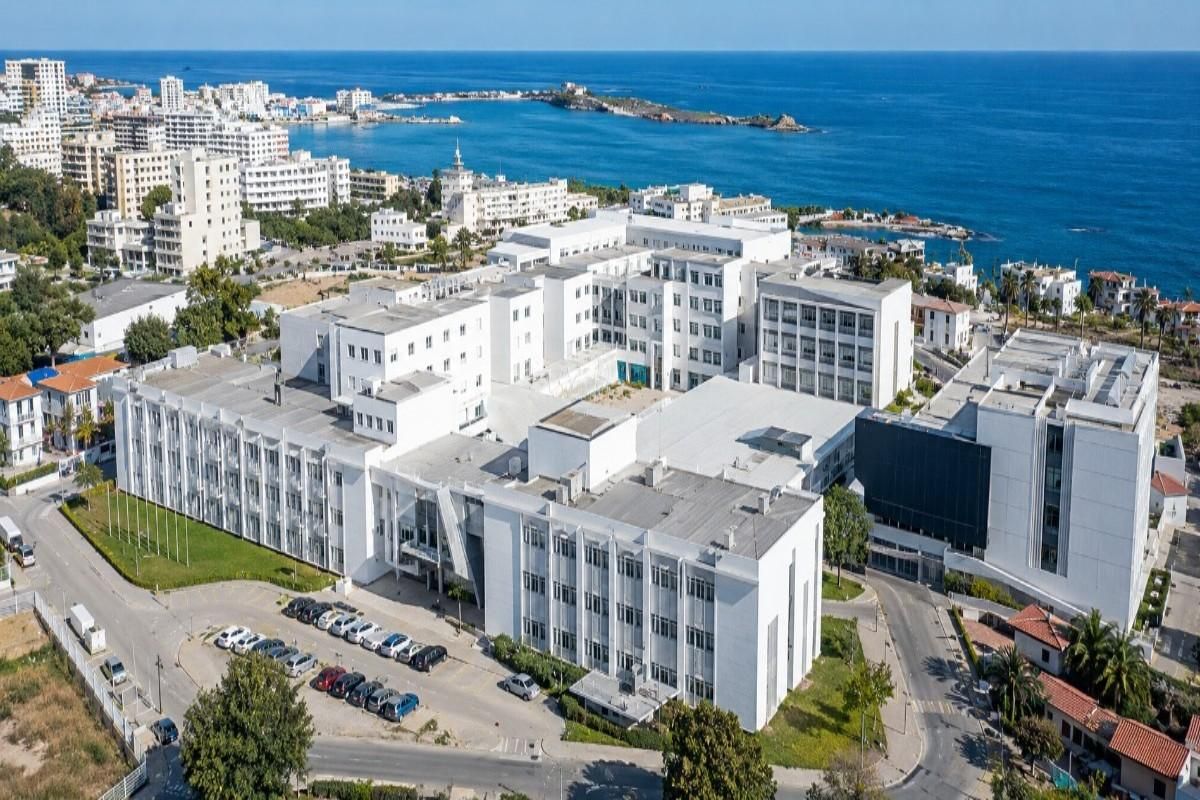
The largest university in Northern Cyprus by student population (26,000+ students), with its own university teaching hospital and JCI-accredited healthcare facilities, a genuine strength for clinical exposure.
Degree: 6-year Medicine (MD)
Tuition: Reported figures range from €10,923 to €11,380/year for Medicine; Medicine and Dentistry are explicitly excluded from NEU’s standard 50% automatic international-student scholarship that applies to most other programs, so don’t assume the discount applies here
Ranking context: THE World Rankings 601-800 band; strong regional standing in the Eastern Mediterranean
Recognition: WDOMS-listed; JCI hospital accreditation is particularly valued for Gulf-country healthcare licensing recognition
Living cost advantage: Northern Cyprus living costs run meaningfully lower than the Republic side, typically €300–€500/month
Note: As a TRNC-based institution, independently verify current FMGL compliance status for the specific intake year before applying; don’t rely solely on consultant claims
Cyprus International University in North Cyprus (clearly labeled: Turkish Republic of Northern Cyprus)
Currently the most affordable English-medium MD program among the universities covered in this guide.
Degree: 6-year Medicine (MD)
Tuition: Figures vary noticeably by source; €7,400/year appears to be the standard post-scholarship figure most commonly cited for the 2026 intake. However, sticker/pre-scholarship figures as high as €12,955 also appear in official-adjacent sources. This is a textbook case of “verify directly before you commit”; ask the university for the exact net figure you will pay in your specific admission year.
Scholarship structure: CIU offers scholarships reviewed every semester based on GPA (50%, 60%, 75%, or up to 100% in some cases), meaning your fee can change year to year based on academic performance, not just a one-time entry discount
Global ranking: THE ranks CIU around 2,500th globally, noticeably behind NEU and EMU, but it holds YÖDAK (North Cyprus higher education authority) accreditation
Admission: No IELTS or entrance exam required by some accounts; verify current policy, as English-proficiency requirements for medical programs specifically can differ from general admission policy
Eastern Mediterranean University in North Cyprus (clearly labeled: Turkish Republic of Northern Cyprus)
Ranked first among North Cyprus universities on Webometrics, with strong engineering accreditation (ABET) alongside its medical program.
Degree: 6-year Medicine (MD)
Tuition: Approximately $12,500/year (already reflecting a 20% standard tuition discount on Medicine; full sticker price is higher)
Fee structure notes: 5% VAT, activity fund, and health insurance are bundled into the quoted figure at EMU, unlike some other universities that list these separately, worth factoring in when comparing headline numbers across universities
Scholarship note: Unlike most programs at EMU, Dentistry is explicitly excluded from scholarship offers; Medicine carries the fixed 20% discount noted above rather than the general 50% international scholarship
Girne American University in North Cyprus (clearly labeled: Turkish Republic of Northern Cyprus)
The lowest headline tuition figure among all six universities in this guide.
Degree: Medicine (English medium)
Tuition: Approximately €5,800/year, noticeably below every other option covered here
Caution: A dramatically lower fee is not inherently a red flag, but it does mean the burden of due diligence is highest here. Before shortlisting GAU, independently confirm current WDOMS listing status, clinical training hospital partnerships, and FMGL-compliance duration for the specific intake year; don’t rely on a single consultancy’s claim that it is “the best medical university in Cyprus,” a claim you’ll see repeated verbatim across several existing blogs without supporting evidence.
Best Medical Universities in Cyprus By Category
There’s no single “best” university in Cyprus; the right answer changes depending on what you’re actually optimizing for. Here’s how the six universities in this guide stack up across different priorities:
Best for overall academic reputation and EU recognition: University of Nicosia, the largest medical school in Cyprus, ECFMG-eligible, with a documented track record of GMC registrations in the UK.
Best for research exposure: University of Nicosia again, given its active research programs in cancer biology, regenerative medicine, and infectious disease, genuinely rare at this scale among the other five options.
Best for clinical exposure via a dedicated teaching hospital: Near East University, on the strength of its JCI-accredited university hospital, a concrete, named clinical asset rather than a generic “hospital partnerships” claim.
Best budget option: Girne American University on headline tuition (€5,800/year), though, as flagged earlier, this comes with the highest independent-verification responsibility of any university in this guide.
Best for a genuinely international environment: European University Cyprus, which draws students from over 70 countries and holds a 5-Star QS rating specifically for its international outlook.
Best mid-range balance (cost vs. ranking vs. accreditation): Cyprus International University, meaningfully cheaper than the Republic-side options, with a broader accreditation footprint than Girne American, though still behind NEU and EMU on global ranking.
Use this as a starting filter, not a final answer; cross-check every category claim against your own priorities and the verification checklist later in this guide before shortlisting.
Cyprus Medical Universities Full Comparison Table
University | Location | Duration | Tuition/Year (approx.) | English Req. | NEET | Clinical Training | Recognition Status |
University of Nicosia | Republic of Cyprus | 6 yrs | €24,000 | IELTS/TOEFL | Required | Cyprus + intl. partner hospitals | EU-recognised, WDOMS, ECFMG-eligible |
European University Cyprus | Republic of Cyprus | 6 yrs | €23,000–€29,000 (tiered) | CEFR B2 | Required | Exclusive hospital agreements | EU-recognised (IMI), GMC-eligible, WDOMS |
Near East University | North Cyprus (TRNC) | 6 yrs | €10,900–€11,400 | Verify per intake | Required | JCI-accredited university hospital | WDOMS-listed; verify FMGL independently |
Cyprus International University | North Cyprus (TRNC) | 6 yrs | €7,400 (post-scholarship, verify) | Verify per intake | Required | University-affiliated hospitals | YÖDAK-accredited; verify FMGL independently |
Eastern Mediterranean University | North Cyprus (TRNC) | 6 yrs | $12,500 | Verify per intake | Required | Hospital rotations, ABET-linked infrastructure | WDOMS-listed; verify FMGL independently |
Girne American University | North Cyprus (TRNC) | 6 yrs | €5,800 | Verify per intake | Required | Verify current hospital partnerships | Verify WDOMS status independently before applying |
NMC Recognition & FMGL Requirements Explained Properly 🔥
This is the section that matters most for your career, and it’s the one where getting the language wrong can genuinely cost you your ability to practice. Let’s be precise.
“NMC Approved University” Is Not a Real Category
You will see the phrase “NMC approved university” or “WHO approved medical college” on almost every competing Cyprus MBBS page. Both claims are technically inaccurate, and it’s worth understanding why:
The WHO does not “approve” medical degrees. What the WHO maintains, jointly with FAIMER, is the World Directory of Medical Schools (WDOMS), a listing/directory of medical schools worldwide that meet certain data-reporting standards. Being listed in WDOMS is a baseline data point, not an endorsement of quality or an “approval.”
The NMC does not maintain a blanket “approved list” of foreign universities either. The old Medical Council of India (MCI) system of an approved-university list was discontinued. What exists now instead is the Foreign Medical Graduate Licentiate (FMGL) Regulations, 2021, issued by the National Medical Commission on 18 November 2021, a rules-based framework that any foreign university’s program either satisfies or doesn’t, based on specific, checkable criteria. There’s no single university-wide “yes/no” stamp; compliance is evaluated per program, per intake batch, based on documented facts about duration, language, and training structure.
The correct, accurate phrasing, and the one this guide uses throughout, is: “Students should independently verify that their specific program satisfies NMC’s FMGL requirements before enrollment.” Any consultant or website using “NMC approved” as a selling point is, at best, using shorthand loosely, and at worst, misleading you about how Indian medical licensing actually works.
The FMGL Regulations, 2021: What They Actually Require
The FMGL Regulations apply to students who began their foreign medical education on or after 18 November 2021. The core requirements, straight from the regulation text:
Minimum 54 months of academic instruction (theory, practical, and clinical training combined), not “approximately 5 years,” not “4.5 years rounded down.” Fifty-four months, exactly, excluding internship. [FMGL Regulation 4(a)(i)]
A mandatory 12-month internship, completed at the same foreign institution where the academic program was undertaken. Students who complete their coursework abroad and try to do their internship back in India, thinking it saves money, are explicitly disqualified under the current rules; this was a common practice before 2021 and is no longer permitted.
English as the medium of instruction for the entire program: this is one reason English-medium destinations like Cyprus have an inherent advantage over countries requiring a local-language foundation year.
Coverage of Schedule I subjects: the syllabus must be equivalent in scope to what’s mandated for MBBS students in India under the Graduate Medical Education Regulations, 1997 (as amended in 2019).
The NEET requirement remains permanent and non-negotiable for the eventual right to sit India’s licensing screening test.
A 10-year completion cap: the entire foreign medical education, including the 12-month internship, must be completed within 10 years of the date of joining. [Reg. 2(iv), Schedule I] This clock starts on Day 1 of enrollment, not on graduation, so students who take extended breaks or repeat years need to track this carefully.
The applicable NMC screening test (currently NExT, National Exit Test, which is progressively replacing FMGE) must be cleared for permanent registration to practice in India.
A 6-year Cyprus MD comfortably meets the 54-month minimum; this is one genuine structural advantage Cyprus programs have over some shorter foreign MBBS programs that cram coursework into fewer months to save on fees.
Can Indian Students Complete Internship in India Instead of Cyprus?
No, not under the current regulation, for students who enrolled after 18 November 2021. The 12-month internship must be completed at the same foreign institution abroad. This is a deliberate tightening of the pre-2021 rules, specifically to close a loophole that allowed students to complete a cheaper or shorter internship in India after finishing coursework abroad. If your enrollment predates November 2021, older transitional rules may apply, but for anyone reading this guide about 2026-27 admission, the current 12-month-abroad rule is what applies to you.
MBBS in Cyprus Fees 2026–27
Getting a reliable MBBS fee structure for 2026- 27 in Cyprus turned out to be harder than expected; even official-adjacent sources disagree on the same university’s numbers. The honest starting point here is that university fee pages themselves are often inconsistent, sometimes listing different figures for the same program on different sub-pages of their own websites. The table below reflects the most recent, most corroborated figures from multiple independent sources as of August 2026, but treat every number as a planning estimate and get written confirmation from the admissions office before paying anything.
University | Annual Tuition (Medicine) | Application Fee | Notable Additional Fees |
University of Nicosia | €24,000 | €60 | Admin fee €1,000 (one-time); health insurance €180/yr; malpractice insurance €300/yr (Yrs 1-3), €6,000/yr (Yrs 4-5); visa fee €150 |
European University Cyprus | €23,000 (Yrs 1-3) → €25,000/€29,000 (Yrs 4-6) | €200 | Tiered fee structure based on internship track (EU vs US-based) |
Near East University | €10,900–€11,400 | Verify at application | No automatic scholarship on Medicine (unlike most other NEU programs) |
Cyprus International University | €7,400 (verify, figures range up to €12,955 pre-scholarship) | Verify at application | Scholarship reviewed every semester based on GPA, not fixed at entry |
Eastern Mediterranean University | $12,500 | Verify at application | 5% VAT + activity fund + health insurance bundled into quoted figure |
Girne American University | €5,800 | Verify at application | Lowest headline fee, highest verification burden |
MBBS in Cyprus Fee Structure Breakdown What “Tuition” Doesn’t Include
Almost every university adds fees beyond the headline tuition number. Budget for these separately:
Application/registration fee: €60–€200 (one-time)
Health/medical insurance: €150–€250/year (mandatory for non-EU students)
Malpractice/liability insurance: Can rise sharply in clinical years. University of Nicosia’s jump from €300/year to roughly €6,000/year in Years 4- 5 is a good example of how a “cheap” early-year fee can look very different by Year 4
Lab and exam fees: Program-specific, generally €200–€800/year depending on university
Visa/residence permit administration: €55–€150 depending on university and whether it’s initial application or annual renewal
Year-Wise Fee Escalation Risk
This is a disclosure almost no competing MBBS-in-Cyprus content makes, and it matters more than most students realize when they’re comparing “Year 1 fee” across universities. Several Cyprus universities increase tuition annually, sometimes by a fixed percentage, sometimes tied to clinical-year cost increases (as with the University of Nicosia’s malpractice insurance jump or the European University Cyprus’s built-in Year 4-6 step-up). A university that appears to be the cheapest option based solely on its entry-year fee can end up costing as much as, or more than, a competitor by Year 6. When comparing universities, ask specifically for a year-by-year fee table for the full six years, not just the first-year number, and get it in writing.
Refund and Withdrawal Policy Considerations
Refund policies differ significantly by university and are rarely publicized prominently. Before paying any deposit or first-year fee, get written clarity on: what portion (if any) of the application fee is refundable if you’re not admitted; what happens to paid tuition if you withdraw before the semester starts versus after it begins; and whether partial-semester withdrawal entitles you to a pro-rated refund. Several of the “international student guarantee” or “guarantee deposit” fees mentioned above (e.g., University of Nicosia’s €400 guarantee) are explicitly refundable under specific conditions; confirm those conditions rather than assuming.
Total Cost of MBBS in Cyprus for Indian Students
Tuition is only part of the real number. Here’s a complete, itemized annual and six-year estimate, split by side of the island, with current INR conversion (1 EUR = ₹110, 1 USD = ₹95.7 as of August 2026).
Republic of Cyprus (University of Nicosia / European University Cyprus) Illustrative Annual Budget
Expense Head | Annual Cost (EUR) | Annual Cost (INR, approx.) |
Tuition | €23,000–€25,000 | ₹25.3L – ₹27.5L |
Hostel/accommodation | €3,600–€7,200 (€300–€600/month) | ₹4L – ₹7.9L |
Food (if not covered by hostel) | €1,800–€3,000 | ₹2L – ₹3.3L |
Health/malpractice insurance | €480–€780 (rises in clinical years) | ₹5.3L – ₹8.6L (Years 4-5 spike) |
Local transport | €480–€960 | ₹0.5L – ₹1.1L |
Personal/miscellaneous | €1,200–€2,400 | ₹1.3L – ₹2.6L |
Estimated annual total (non-clinical years) | €30,500 – €39,000 | ₹33.5L – ₹43L |
Approximate 6-year total (Republic of Cyprus, all-in, tuition + living + insurance): roughly €180,000–€210,000, or approximately ₹1.98 crore – ₹2.31 crore, factoring in the clinical-year insurance and fee increases discussed above. This range is broadly consistent with third-party estimates that place the University of Nicosia’s full six-year cost around €185,000.
North Cyprus (NEU / CIU / EMU / GAU) Illustrative Annual Budget
Expense Head | Annual Cost (EUR/USD equivalent) | Annual Cost (INR, approx.) |
Tuition | €5,800–€12,500 | ₹6.4L – ₹13.8L |
Hostel/accommodation | €1,800–€4,800 | ₹2L – ₹5.3L |
Food | €1,200–€2,400 | ₹1.3L – ₹2.6L |
Insurance and misc. university fees | €300–€800 | ₹0.3L – ₹0.9L |
Local transport | €240–€600 | ₹0.3L – ₹0.7L |
Personal/miscellaneous | €900–€1,800 | ₹1L – ₹2L |
Estimated annual total | €10,240 – €22,900 | ₹11.3L – ₹25.2L |
Approximate 6-year total (North Cyprus, all-in): roughly €65,000–€130,000, or approximately ₹71.5 lakh – ₹1.43 crore, depending heavily on which of the four universities you choose; the gap between Girne American’s €5,800/year and EMU’s $12,500/year compounds significantly over six years.
One-Time and Recurring Costs Not to Forget
Flights: ₹35,000–₹65,000 round trip per year, depending on season and route (typically via Istanbul, Dubai, or Doha)
Visa/residence permit fees: €55–€150 depending on university and whether it’s a first application or annual renewal
Initial setup costs: bedding, books, SIM card, initial groceries, budget roughly €300–€500 for the first month beyond regular expenses
Currency fluctuation buffer: Given that INR/EUR and INR/USD rates move meaningfully year to year (the EUR/INR rate alone has ranged between roughly ₹105 and ₹111 through 2026), build in a 5- 8% buffer on your annual budget rather than locking your financial plan to today’s exchange rate
Cost of Living in Cyprus
Republic of Cyprus (Nicosia)
Category | Monthly Cost (EUR) |
University hostel | €300–€600 |
Private shared room | €250–€500 |
Private 1-bedroom apartment (city center) | €700–€1,000+ |
Food (self-cooked, weekly grocery ~€ 60- € 85 for one) | €250–€350 |
Food (mix of cooking and eating out) | €350–€500 |
Indian groceries/restaurants | Available, priced slightly above local staples |
Utilities (electricity, water, 85m² apt) | €100–€160 |
Mobile/internet | €25–€45 |
Local transport (monthly pass) | €55–€65 |
Total realistic student budget (excluding tuition) | €800–€1,000/month |
North Cyprus (Nicosia-North, Kyrenia, Famagusta, Lefke)
Category | Monthly Cost (EUR equivalent) |
University dormitory (often bundled with meals in “all-inclusive” packages) | €150–€400 |
Private shared apartment | €150–€350 |
Food | €150–€300 |
Utilities | €60–€100 |
Total realistic student budget (excluding tuition) | €300–€500/month |
North Cyprus living costs consistently run 30- 50% lower than on the Republic side, which is one of the genuine, verifiable reasons North Cyprus universities remain attractive despite the additional recognition-verification burden discussed earlier. Near East University, in particular, markets “all-inclusive” packages (tuition + dorm + food) starting around €4,400/year for non-medical programs, which raises the question of whether a similar bundled option exists specifically for medical students.
Scholarships & Financial Aid
Scholarship claims are one of the most inflated areas of MBBS-abroad marketing; “up to 60% scholarship” headlines are everywhere, almost always without specifying who actually qualifies. Here’s what’s verifiably true per university, based on official sources:
University | Scholarship Reality (Verified) |
University of Nicosia | Up to 20-30% based on demonstrated financial need, applied via a separate scholarship application after admission, not automatic, not guaranteed at entry. |
Near East University | 50% automatic scholarship applies to most programs but is explicitly excluded for Medicine and Dentistry |
Cyprus International University | GPA-based scholarships (50%, 60%, 75%, up to 100%) reviewed every semester, not fixed at entry; your fee can change year to year based on academic performance. |
Eastern Mediterranean University | Fixed 20% discount on Medicine tuition (already factored into the $12,500 figure above); the general 50% international scholarship does not apply to Medicine |
Girne American University | Scholarship structure varies; verify the current terms directly, as third-party sources are inconsistent. |
The honest takeaway: scholarships for Medicine specifically are consistently smaller, harder to qualify for, or entirely excluded compared to the flashy “50-60% off” headline figures that apply to non-medical programs at the same universities. Don’t budget your finances around a scholarship percentage you haven’t confirmed, in writing, applies specifically to the medicine program for your admission year.
Education Loan Options for Indian Students
Most major Indian banks (SBI, Bank of Baroda, PNB, and several private lenders) offer education loans for MBBS abroad, typically covering tuition and a living-expense component, and usually requiring collateral for loan amounts above ₹7.5–10 lakh, depending on the bank’s policy. Because Cyprus doesn’t yet have the loan-scheme familiarity that countries like Georgia or the Philippines have built up with Indian lenders, it’s worth having your university’s WDOMS listing and fee-structure documentation ready when you approach a bank; loan officers unfamiliar with the destination will ask for it.
Travel Guide
For parents transferring tuition and living funds, standard LRS (Liberalized Remittance Scheme) guidelines apply for outward remittances from India, currently allowing individuals to remit up to $250,000 per financial year for education purposes, subject to your bank’s specific documentation requirements (admission letter, fee structure, and Form A2 declaration are typically required). Comparing wire-transfer margins across a couple of authorized dealers or forex platforms before your first large payment is worth the ten minutes it takes; margins on EUR/USD transfers can vary meaningfully between providers.
MBBS Curriculum in Cyprus
The six-year structure is broadly similar across universities, though exact year-by-year breakdowns vary:
Phase | Years | Focus |
Pre-clinical | Years 1-2 | Anatomy, Physiology, Biochemistry, Pathology, foundational sciences |
Clinical (early) | Years 3-4 | Internal Medicine, Surgery, Pediatrics, Obstetrics & Gynecology, hospital rotations begin. |
Clinical (advanced) | Year 5 | Specialty rotations: Cardiology, Neurology, Orthopedics, Radiology, Emergency Medicine |
Internship | Year 6 | Mandatory 12-month rotating internship at the same institution (per FMGL requirement) |
Assessment methods typically combine written examinations, OSCE (Objective Structured Clinical Examination) stations for practical/clinical skill evaluation, and continuous clinical assessment during hospital rotations, broadly aligned with international medical education norms rather than a single standardized Cyprus-wide format.
Clinical Training & Internship in Cyprus
Clinical exposure generally begins in Year 3, structured as rotations across major specialties: Internal Medicine, General Surgery, Pediatrics, Obstetrics & Gynecology, Psychiatry, Cardiology, Orthopedics, Radiology, and Emergency Medicine. Near East University’s JCI-accredited university hospital is a distinct, named clinical training asset worth highlighting; JCI accreditation is internationally recognized and particularly relevant if you’re considering a career path to the Gulf region afterward. University of Nicosia and European University Cyprus rely on a mix of public/private Cypriot hospitals and, for some students, international partner clinical sites (which, as noted earlier, can carry additional supplement fees).
The mandatory 12-month internship, as established under FMGL 2021, must be completed at the same institution where you completed your academic coursework; this is non-negotiable for students who enrolled after November 2021, regardless of what any consultant may suggest about “flexibility.”
Named Hospital Tie-Ups: What’s Actually Verifiable
Most Cyprus MBBS content online talks about “hospital partnerships” in the abstract without naming a single one; here’s what could actually be confirmed, and where you need to ask directly:
Near East University operates its own university teaching hospital in North Nicosia, JCI-accredited, and this is the clearest, most concrete named clinical asset among all six universities in this guide.
University of Nicosia places students across public and private Cypriot hospitals, and, for some students in the final two years, international partner clinical sites (which carry the additional supplement fee noted earlier). The university does not publicly list every specific partner hospital on its general admissions pages, so ask directly for the current clinical site list for your intake year.
European University Cyprus maintains what it describes as “exclusive agreements with major public and private hospitals” for core rotations and summer externships, again without a fully public, named list at the time of writing.
Eastern Mediterranean University, Cyprus International University, and Girne American University, specific named teaching-hospital partnerships for Medicine were not independently verifiable from public sources at the time of writing. This is exactly the kind of detail to request directly in writing before enrolling: ask for the names of the specific hospitals where Year 3-6 clinical rotations take place.
Pros and Cons of Accommodation Options
Pros | Cons |
On-campus, secure, easiest for first-year students | Less privacy, limited cooking facilities in some cases |
More independence, cook your own meals. | Requires searching, separate utility bills |
Full privacy | Significantly more expensive |
Safety, Health Insurance & Student Support
Health insurance is mandatory for all non-EU students, typically costing €150–€250/year at Republic-side universities (rising during clinical years due to malpractice insurance components, as detailed in the University of Nicosia fee breakdown above). Most universities maintain on-campus health centers for routine care, with referral pathways to public or private hospitals for anything beyond basic treatment. Campus security is generally robust across the universities covered here, with 24/7 surveillance and access-controlled residential buildings being standard rather than exceptional.
Ragging and Campus Safety Specifics
Ragging in the Indian sense, organized, targeted harassment of new students by seniors, is not a documented or culturally established practice at Cyprus universities, unlike at some Indian institutions. That said, general campus-safety fundamentals still apply and are worth confirming directly with your shortlisted university: whether an anti-harassment/anti-bullying policy exists in writing, whether an international student office handles complaints confidentially, and whether orientation programs specifically address reporting channels for any form of harassment (peer-to-peer or otherwise). Most universities in this guide run structured orientation weeks specifically to integrate new international students, which meaningfully reduces the isolation that often enables ragging-like behavior in less-supervised environments.
Campus Tours and Virtual Walkthroughs
Before committing, it’s worth requesting a virtual campus tour or walkthrough video from your shortlisted university’s admissions office; most run these as part of their international-recruitment process, even if not always prominently linked on the main website. This matters more for Cyprus specifically than for many destinations, because the gap between marketing photography and the actual hostel/lab experience is exactly the kind of thing “real photos, not stock images” (an E-E-A-T priority discussed below) is meant to catch. If a university can’t or won’t provide a current walkthrough video or live video call tour, treat that as a data point in itself.
Advantages of MBBS in Cyprus
Genuinely English-medium education throughout, no local-language foundation year
EU-recognised degrees available (Republic of Cyprus institutions specifically)
No NEET-cutoff bottleneck at admission, access is broader than India’s domestic seat competition
Modern simulation labs and, at some universities, JCI-accredited clinical training hospitals
Safe, low-crime environment by international student-destination standards
Multiple licensing pathways available post-graduation (India, UK, USA, EU) depending on university and program
A six-year duration that comfortably satisfies the NMC’s 54-month minimum requirement
Disadvantages of MBBS in Cyprus
Being direct here, because almost nobody else is:
Republic of Cyprus tuition is genuinely expensive: €22,000-€29,000/year puts a six-year total north of €180,000, competitive with or exceeding mid-tier private medical colleges in India
North Cyprus regulatory ambiguity: The TRNC’s lack of international recognition adds a real, ongoing verification burden that doesn’t exist with EU-recognised destinations, and this isn’t something that resolves itself; it requires your continued diligence
Currency fluctuation risk: With a six-year commitment and fees quoted in EUR or USD, INR depreciation over the course of your degree can meaningfully increase your total rupee-denominated cost beyond what you budgeted at enrollment
Limited number of medical schools: Compared to destinations like Georgia, Uzbekistan, or the Philippines, which offer far more university choice at comparable or lower price points
Distance from home: Cyprus isn’t a quick or cheap trip back to India, and this matters over six years
Year-wise fee escalation: As detailed earlier, meaning your actual six-year cost can run meaningfully higher than a Year 1 quote suggests
Inconsistent public information: As this guide’s own research process demonstrated repeatedly, even official-adjacent sources disagree on basic fee figures for the same university and program, which places more research burden on you than destinations with more standardized, centralized information
Who Should Choose MBBS in Cyprus?
Cyprus tends to make sense for students who: want a genuinely English-medium EU-recognised degree and can afford the Republic-side fee range without excessive financial strain; are drawn specifically to Near East University’s JCI-hospital clinical exposure for a future Gulf-region career; value Cyprus’s safety, climate, and lower Western-Europe cost of living compared to the UK or mainland EU; and are willing to do the independent verification work this guide has modelled throughout, rather than relying entirely on a single consultant’s claims.
Who Should NOT Choose MBBS in Cyprus?
Equally directly: Cyprus is probably not the right fit if you’re a genuinely low-budget student for whom even North Cyprus’s €65-90 lakh six-year total is a financial stretch; several other MBBS-abroad destinations offer lower total costs meaningfully. It’s also not the right choice if you’re unwilling to verify NMC FMGL compliance independently and would rather rely entirely on a consultant’s verbal assurance, given how inconsistent public information about Cyprus universities currently is; that’s a genuinely risky approach here. And it’s not the right choice if you’re expecting any foreign medical degree, Cyprus included, to grant “automatic worldwide recognition”. Every destination, Cyprus included, requires you to clear destination-specific licensing (NExT for India, PLAB for UK, USMLE for USA) regardless of where you studied.
MBBS in Cyprus vs Other Countries
Country | Approx. Tuition/Year | Approx. Living Cost/Month | English Medium | NMC/FMGL Duration Fit | Notable Trade-off |
Cyprus (Republic side) | €22,000–€29,000 | €800–€1,000 | Yes | 6 yrs, comfortably meets 54-month minimum | Higher cost, strong EU recognition |
Cyprus (North side) | €5,800–€12,500 | €300–€500 | Yes | 6 yrs, meets minimum; verify per university | Lowest Cyprus cost, highest verification burden |
Georgia | ₹ 4- 6 lakh/year (approx.) | Lower than Cyprus | Yes | Widely used FMGL-compliant destination | More university choice, larger established Indian-student ecosystem |
Uzbekistan | Among the lowest in the region | Very low | Partial/mixed | Verify per university | Lowest cost, but language and infrastructure vary widely by institution |
Kazakhstan | Low-mid range | Low | Partial/mixed | Verify per university | Established Indian-student pipeline, NEET-scholarship options at some universities |
Armenia | Low-mid range | Low | Yes (mostly) | Widely used FMGL-compliant destination | Large, established Indian-student community |
Romania | Mid-high (EU) | Moderate | Yes | EU-recognised | Similar EU-recognition profile to Republic of Cyprus at often comparable or higher cost |
Bangladesh | Lower than Cyprus | Lower | Partial | Verify per university | Proximity to India and cultural familiarity, but the degree recognition profile differs. |
Cyprus’s genuine differentiator against this set isn’t being the cheapest; it clearly isn’t, especially on the Republic side. It’s the combination of full English-medium instruction with EU degree recognition at Republic-side institutions, something few of the lower-cost alternatives offer simultaneously.
Career Opportunities After MBBS in Cyprus
Graduates can pursue multiple pathways depending on university and personal choice: practising in India after clearing NExT; pursuing PG specialisation in India, the UK, USA, or elsewhere in Europe; working within the EU healthcare system (Republic-side graduates specifically, given EU degree recognition); pursuing US residency via the USMLE pathway (University of Nicosia graduates are explicitly ECFMG-eligible, for instance); or working in Gulf-region healthcare systems, where JCI-accredited training (Near East University specifically) is a genuinely relevant credential. Non-clinical paths, medical research, public health, health-tech, are also increasingly viable given the research infrastructure at institutions such as the University of Nicosia.
Licensing Pathways After Graduation
Destination | Licensing Exam | Notes |
India | NExT (National Exit Test), progressively replacing FMGE | Mandatory NEET at entry remains a separate, permanent requirement |
United Kingdom | PLAB 1 and PLAB 2, then GMC registration | GMC-eligible degrees specifically at University of Nicosia and European University Cyprus |
United States | USMLE Steps 1, 2, 3 | Requires ECFMG eligibility; confirm your specific university/program qualifies |
EU/Germany | Automatic EU recognition for Republic of Cyprus degrees under EU medical directives; language requirements (German) apply for clinical practice in Germany specifically | North Cyprus degrees do not carry the same automatic EU recognition as those from the EU. |
Middle East (UAE, Saudi Arabia, Qatar) | DataFlow verification + local licensing exams (e.g., Prometric) | JCI-accredited clinical training (Near East University) is specifically valued here |
Expected Salary After MBBS/MD
Context | Approximate Range |
India (post-NExT, entry-level, government) | ₹6-10 lakh/year |
India (private practice, established) | ₹12-25 lakh/year and above, highly variable |
UK (NHS, post-PLAB, junior doctor) | £32,000-£45,000/year (approx. ₹34-48 lakh) |
USA (post-residency match) | $220,000-$300,000+/year for many specialties (approx. ₹2.1-2.9 crore), highly specialty-dependent |
Middle East (post-licensing) | Tax-free packages, highly variable by country, specialty, and experience |
How to Choose the Right Medical University in Cyprus
An independent verification checklist, worth running through for any Cyprus university you’re considering, including the six covered in this guide:
Confirm the university’s current WDOMS listing status directly on the official WDOMS website, not just via a consultant’s claim
Check accreditation status specific to the country side (EU accreditation for Republic-side; YÖDAK for North Cyprus)
Request the exact, current fee table for your specific intake year, in writing, from the admissions office, not a website figure that could be outdated
Ask specifically about clinical training hospital partnerships and whether any additional supplement fees apply during clinical years
Verify whether any quoted scholarship applies specifically to Medicine, and whether it’s guaranteed at entry or reviewed periodically
Confirm current visa/residence permit processing requirements for your specific nationality
Ask for contact details of current Indian students at the university, if possible, for an unfiltered perspective
Cross-check every claim in this guide, and every claim any consultant makes, against the university’s own official published information before making a final decision
2026–27 Admission Timeline
Stage | Approximate Window |
NEET exam (for Indian applicants) | May 2026 |
University shortlisting and research | Ongoing through mid-2026 |
IELTS/TOEFL (if required) | Complete by June-July 2026 |
Document preparation | June-July 2026 |
Application submission | July-August 2026 (rolling for most universities) |
Offer letter and scholarship decision | August 2026 (scholarship deadlines often earlier, confirm per university) |
Fee payment/deposit | Per university deadline, typically August |
Visa application | Immediately after offer/deposit, allow 4-6 weeks for processing. |
Travel and arrival | Late August-early September 2026 |
Registration and orientation | September 2026 |
Semester start | September 2026 (primary intake) |
Common Myths About MBBS in Cyprus Busted
Myth: “Cyprus medical degrees are NMC approved.” Reality: There’s no such thing as a blanket “NMC approved” foreign university anymore. What exists is FMGL compliance, evaluated per program against specific, checkable criteria; verify it yourself rather than accepting the phrase at face value.
Myth: “North Cyprus and Republic of Cyprus are basically the same for practical purposes.” Reality: They differ meaningfully in international recognition, banking, visa processing, and the verification burden placed on you, covered in detail earlier in this guide.
Myth: “The cheapest university is automatically the best value.” Reality: Year-wise fee escalation, clinical-year insurance spikes, and inconsistent scholarship eligibility mean the true six-year cost can look very different from the headline Year 1 figure.
Myth: “Any Cyprus MBBS degree guarantees automatic worldwide practice rights.” Reality: Every destination-specific licensing exam (NExT for India, PLAB for UK, USMLE for USA) remains mandatory regardless of where you studied.
Conclusion
MBBS in Cyprus isn’t a single, simple decision; it’s really two distinct decisions wearing the same island’s name. Choose the Republic of Cyprus, and you’re paying a genuinely premium European price for a cleanly EU-recognised degree. Choose North Cyprus, and you’re getting dramatically lower costs alongside a real, ongoing responsibility to verify recognition and compliance yourself, university by university, intake by intake. Neither path is wrong, but walking in without understanding that distinction, or trusting a blanket “NMC approved” claim at face value, is how students end up with expensive, avoidable problems years into their degree. Do the verification work this guide has modeled throughout, check WDOMS listings directly, get fee tables in writing, confirm FMGL compliance for your specific program, and MBBS in Cyprus can be a genuinely solid, English-medium route into medicine for the right student and the right budget.
Decision Scorecard MBBS in Cyprus at a Glance
A quick-reference snapshot pulling together the ratings and core facts already detailed throughout this guide, for anyone who wants the summary before the full read.
Factor | Rating (out of 5) |
Affordability | ★★★☆☆ (North Cyprus meaningfully cheaper than the Republic of Cyprus) |
Academic Quality | ★★★★☆ (varies by university, Nicosia and European University Cyprus lead) |
Clinical Exposure | ★★★★☆ (varies, JCI-accredited hospital ties strongest at Near East University) |
Safety | ★★★★☆ |
Student Life | ★★★★☆ |
Cost of Living | ★★★☆☆ (Republic side runs 30–50% higher than North Cyprus) |
International Recognition | ★★★☆☆ (Republic = EU-recognised; North Cyprus/TRNC needs independent verification) |
Climate Tolerance Needed | ★★☆☆☆ (Mediterranean, mild winters, no extreme cold to plan around) |