Q1 Is the programme in English?
+Yes, entirely. No Latvian required for admission.

 Latvia | Est. 1919
Latvia | WDOMS listed; EU Directive 2005/36/EC; Ministry of Education and Science Latvia; ECFMG eligible; GMC UK via PLAB/portfolio | English (full programme; no Latvian required for admission) medium
Expert will call you within 2 hours
The University of Latvia has been around since 1919; founded just weeks after the country declared independence; and its Faculty of Medicine is almost as old, having opened its doors in September of that same year. That history matters, not just as a talking point, but because it shaped the kind of institution FMLS is today: a serious, publicly funded university with deep roots in Latvian academic life, not a recently incorporated private college chasing international enrolment. When you study medicine here, you are walking into a tradition that is over a hundred years old. That is not something you can manufacture.
The faculty went through a significant change in 2024, when it merged with the Faculties of Biology and Chemistry, along with several research institutes, to become the Faculty of Medicine and Life Sciences. On paper it sounds administrative. In practice, it means students now study within the same academic unit as the Institute of Cardiology and Regenerative Medicine, the Institute of Clinical and Preventive Medicine, the Institute of Microbiology and Biotechnology, and the Institute of Biology. That kind of integration; where clinical training and active research genuinely coexist under one roof; is harder to find than most universities will admit. Students are not just being trained as clinicians; they are surrounded by researchers who are actively pushing the boundaries of what medicine understands about the human body.
The University of Latvia sits at 801–850 globally in the QS World University Rankings 2026 and holds the top position among Latvian universities by multiple national measures. In QS Subject Rankings, its Medicine and Health Sciences programmes are placed at 601 globally; the highest-ranked medical programme in the country. It is a member of the European University Association, the Utrecht Network, and UNICA, with academic partnerships spread across Europe and North America. Research is conducted across more than fifty fields, and the faculty's output in cardiology, regenerative medicine, microbiology, and epidemiology carries real international standing.
The six-year MD programme is taught entirely in English. That is not a marketing detail; it genuinely changes the experience of studying here for international students. No language barrier on day one, no scrambling to learn Latvian before you can follow a lecture. You arrive, and you get to focus on medicine. The programme runs to 360 ECTS credits, structured in line with the EU's Bologna Process, and is fully compliant with EU Directive 2005/36/EC on professional qualifications. What that means practically: graduates hold a degree that is automatically eligible for recognition across all 27 EU member states, without going through individual country-by-country applications. That single fact opens up an enormous amount of career flexibility that a non-EU degree simply cannot offer.
For Indian students specifically, the programme is listed in the World Directory of Medical Schools and is recognised by the National Medical Commission, making graduates eligible to sit the NExT examination after completing the mandatory internship in Latvia. FMLS graduates are also ECFMG-eligible for the USMLE pathway into US residency, and can pursue GMC registration in the UK via PLAB or the portfolio route. It is a degree that genuinely travels; which is a real consideration when you are committing six years of your life and a substantial amount of money to a qualification. Knowing that the degree works in India, the EU, the UK, and the US before you even begin is a level of certainty that not every medical school abroad can offer you.
Clinical exposure begins in Year 3, with supervised patient contact and structured clinical examination training. Full hospital rotations run through Years 4 to 6, based primarily at Pauls Stradiņš Clinical University Hospital; Latvia's largest hospital, with 840 beds. It has served as the University of Latvia's main teaching hospital since 1928 and functions today as a national referral centre for cardiovascular medicine, neurology, oncology, and emergency care. Students here are not working in a small regional hospital where the caseload is limited. They are in a tertiary centre handling genuinely complex cases from across the country; the kind of clinical exposure that sharpens diagnostic thinking in ways that a quieter training environment cannot replicate. Additional placements at affiliated hospitals in Riga and the wider metropolitan area add breadth, covering both specialist hospital medicine and community healthcare settings.
Riga itself is worth taking seriously as part of the decision. It is a UNESCO World Heritage Site with one of the finest collections of Art Nouveau architecture in Europe, a functioning capital city with excellent public transport, and a genuine student culture built around a population that has had universities in it for over a century. It also costs considerably less to live in than London, Dublin, Paris, or Amsterdam. Most students manage comfortably on €500–800 per month covering accommodation, food, transport, and personal expenses. University dormitory accommodation starts from as little as €100–150 per month. For a full EU medical education delivered in English, that combination of quality and affordability is genuinely rare; and it is worth being honest that this matters when you are planning a budget across six years.
FMLS is housed across two sites in the Torņakalns district of Riga; pre-clinical and research facilities at Jelgavas iela 1 in the Science House building, and medical and health sciences programmes at Jelgavas iela 3. The faculty is led by Dean Professor Kristaps Jaudzems, a Doctor of Chemical Sciences. That choice of dean says something about the faculty's identity: this is not a medical school that sees itself as a standalone clinical training operation. It is an integrated science and medicine institution, and the leadership reflects that.
Finally, it is worth being direct about what sets FMLS apart from the private medical universities that have expanded rapidly across Eastern Europe over the past two decades. FMLS is part of Latvia's oldest and most prestigious public research university. It is state-funded, nationally accredited, and backed by major research institutes with decades of scientific output behind them. The degree carries institutional weight that comes from a century of academic history; not from a recently issued operating licence and an aggressive overseas recruitment strategy. For students who want the security of studying at a genuine public university within the European Union, with a qualification that holds up to scrutiny wherever they take it, FMLS is one of the more credible and honest options on the table.
No hidden charges, no donation. The full picture of costs at MBBS In University of Latvia Faculty of Medicine and Life Sciences.
Tuition Fee
Year 1: €11,262 | Year 2: €11,550 | Year 3–4: €12,128 | Year 5: €12,705 | Year 6: €13,860 Total 6-year tuition: approx. €73,633(₹66–68 lakh)
€73,633 over 6 years (₹66–68 lakh). Application fee €170.Non-EU/EEA deposit €500
Hostel Fee
: University dormitory €100–150/month; shared apartment €300–450/month; private studio €450–600/month
University dormitory €100–150/month; shared apartment €300–450/month
Food & Meals
€150–250
Per Month
Insurance
€200–400
Per year
Donation
No donation
No hidden charges
Total Estimated Cost
€90,000–100,000 all-inclusive (₹81–90 lakh)
6 Year
25–35%
Average FMGE first-attempt pass rates for students from many overseas medical universities. Students from structured programs consistently score higher.
Students returning to India need to clear the FMGE/NExT exam. MBBS In University of Latvia Faculty of Medicine and Life Sciences integrates exam-oriented coaching into the regular curriculum so students are prepared from day one.
A structured program that takes you from foundational sciences to clinical mastery.
Cell Biology, Medical Latin, Physics, Psychology and Basics of Psychiatry, Introduction to Medical Studies
Anatomy, Inorganic and Organic Chemistry
Microbiology and Immunology, Biophysics, Medical Statistics
Histology and Embryology, Physiology, Biochemistry, Genetics
Semiology and Clinical Examination, Evidence-Based Medicine, Microbiology II; first supervised patient contact this year
Pathophysiology, Pharmacology, Pathological Anatomy, Epidemiology
Obstetrics and Gynaecology, Psychiatry, Radiology and Imaging; based at Pauls Stradiņš and affiliated Riga hospitals
Internal Medicine, General Surgery, Paediatrics
Family and Community Medicine, ENT, Ophthalmology, Dermatology, Orthopaedics, Emergency Medicine
Internal Medicine II, Surgery II, Neurology
must be completed in Latvia; NMC-mandated internship required before NExT.
Internal Medicine, Surgery, Obstetrics and Gynaecology, Paediatrics, Psychiatry, Emergency Medicine, Community Medicine, Elective

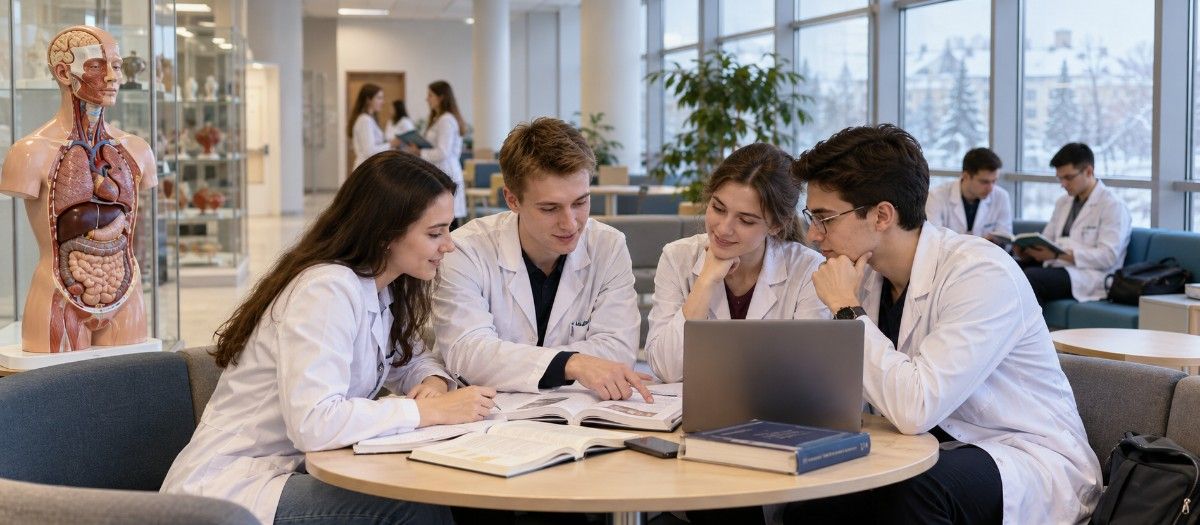
Furnished hostel rooms with Wi-Fi, laundry, 24/7 security, and Indian mess on or near campus.
Indian restaurants and mess facilities serving vegetarian and non-vegetarian home-style food daily.
Strong Indian community with cultural events, festival celebrations, and peer support groups.
Students get hands-on clinical training in government and private hospitals affiliated with the university.
Practical information for students planning to study at MBBS In University of Latvia Faculty of Medicine and Life Sciences.
Prepare for all seasons. Thermal wear for winters, light clothing for summers. University provides heating in hostels.
Student visa processed with university invitation letter. Direct and connecting flights from major Indian cities.
Health insurance included in fees. Medical facility on campus plus city hospitals easily accessible.
Local SIM cards available. WhatsApp and video calls keep you connected with family back home.
Average monthly expenses of $150–$250 covering food, transport, and personal needs.
University library, online databases, and study groups. Seniors mentor juniors through academic challenges.
Our team guides you through every step — from application to arriving on campus.
Latvia specialist explains RSU, EU licence, Baltic region comparison, and total cost versus Estonia and Slovakia.
Full RSU application and Latvian visa document package prepared.
Direct submission to Riga Stradiņš University. Offer letter typically within 10–14 days.
Our team receives the offer, explains the terms, and manages the initial fee payment.
Full documentation submitted to the Latvian Embassy in New Delhi. Begin at least 2 months before departure.
Riga city orientation, RSU campus, accommodation, Baltic transport, banking, SIM card, first-week logistics.
We advise on routing to Riga International Airport (RIX). Confirms arrival with the local team.
Our local Riga coordinator meets you and handles the transfer.
RSU registration and dormitory check-in handled by AMW's local team.
Our team manages the Temporary Residence Permit for Studies application and annual renewal.
Admission Helpline — Contact our counsellors for step-by-step assistance.
“The faculty here is incredibly supportive. The clinical training during hospital rotations has given me real confidence in patient care.”
“Affordable fees without compromising on quality. The campus facilities and hostel life made my transition abroad very smooth.”
“English medium instruction and WHO-recognized curriculum were the deciding factors for me. No regrets so far — excellent experience overall.”
“The university helped with everything from visa to accommodation. Hospital exposure from year three has been invaluable for my FMGE prep.”
“Just cleared my licensing exam on the first attempt. The structured coaching and mock exams during final year were a game-changer.”
“Safe campus, good food options, and a strong Indian student community. The teaching methodology is very practical and hands-on.”
Yes, entirely. No Latvian required for admission.
Yes; listed in WDOMS and recognised by NMC India. Verify current listing at nmc.org.in before applying.
Pauls Stradiņš Clinical University Hospital; Latvia's largest, 840 beds, UL's primary teaching hospital since 1928.
EU-recognised MD valid across all 27 EU states; ECFMG-eligible for USMLE; GMC UK via PLAB; NMC India via NExT after completing Latvia internship.
Supervised patient contact begins Year 3. Full rotations run Years 4–6; Year 6 is a comprehensive supervised internship.
15 May for non-EU/EEA applicants. Results announced around mid-July.
No. There are no donation or capitation fees.
Approximately €500–800/month covering all expenses. One of the most affordable EU capitals for students.
Yes; FMLS graduates are ECFMG-eligible.
FMLS is part of Latvia's oldest public research university, state-funded, nationally accredited, and backed by major research institutes. The institutional credibility and international recognition are in a different category from private alternatives.
Our expert counsellors will guide you through the complete admission process — from documents to airport pickup.
